
Bee in Art -Timeline I Prehistoric and Early Rock Art

c. 40,000–3,000 BCE
Introduction
The relationship between humans and bees began long before written history. Prehistoric communities gathered honey from wild hives and used beeswax as a valuable natural material. Evidence of this interaction appears both in rock paintings and in archaeological remains, revealing how early societies observed and used bees thousands of years ago.
Historical Context
Prehistoric art represents some of the earliest surviving expressions of human culture. Created long before written language, these images appear on cave walls and rock shelters across many regions of the world. Most depict animals, hunting scenes, and elements of daily life, reflecting the close relationship between early human communities and their environment.
Among the natural resources valued by prehistoric people was honey, a highly nutritious food collected from wild beehives. Rock paintings depicting honey gathering show that humans had already developed techniques for locating and harvesting hives thousands of years ago.
Alongside honey, beeswax was also widely used. Beeswax could seal containers, waterproof pottery, bind pigments, and form textured elements in artistic practice.
Scientific studies led by Richard Evershed at the University of Bristol identified chemical traces of beeswax preserved in prehistoric pottery across Europe, North Africa, and the Near East. Using lipid residue analysis, researchers demonstrated that early farming communities were exploiting honeybee products around 8,500 years ago.
These findings confirm that bees were important not only as a source of food but also as providers of materials used in early technologies and artistic practices.
Bees were not only observed — they were already part of how humans lived, stored, and created.
Artwork
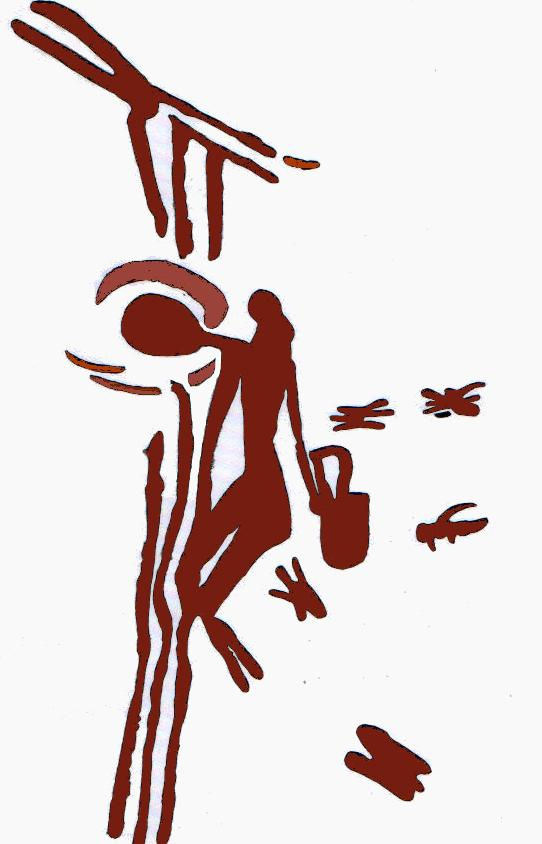
1. Honey-Gathering Scene
Cuevas de la Araña (Bicorp, Spain)
c. 8000–6000 BCE
Rock painting
One of the earliest known visual representations of human interaction with bees appears in a rock painting from Cuevas de la Araña in eastern Spain. The image shows a human figure climbing a steep rock face toward a cavity containing a wild beehive while surrounded by a swarm of bees.
The composition emphasizes the physical effort and risk involved in collecting honey. The climber appears suspended by a rope or vine while reaching into the hive, possibly using a container to collect honey.
In this scene, bees are not symbolic figures but part of a practical activity essential to survival. The painting records a moment of interaction between humans and the natural world and reflects early knowledge of bee behavior and honey harvesting.

2. Beeswax Rock Art
Arnhem Land, Northern Territory, Australia
c. 2000 BCE (approx.)
Beeswax applied to rock surface
In some prehistoric cultures, bees contributed not only as subjects of imagery but also as materials used in artistic practice. Archaeological evidence from Arnhem Land in northern Australia shows that beeswax was used to create rock art motifs, sometimes combined with pigments or applied directly to rock surfaces.
These works demonstrate how natural materials obtained from bees could become part of artistic techniques, producing textured or raised elements within the composition.
Transition to the Next Period
In prehistoric contexts, bees appear primarily in connection with survival and material use. They are associated with honey gathering and early technological practices.
In later civilizations, however, bees begin to acquire symbolic meanings. In ancient cultures such as Egypt and the Aegean world, the bee becomes associated with sacred order, royal authority, and divine power.
The next chapter will explore how the bee moves from prehistoric rock art into the symbolic systems of early civilizations.
References
Cuevas de la Araña
Honey hunting
Evershed, R. et al.
Widespread exploitation of the honeybee by early Neolithic farmers
Images source: Wikimedia Commons.


Comments